
Manufacturing and R&D
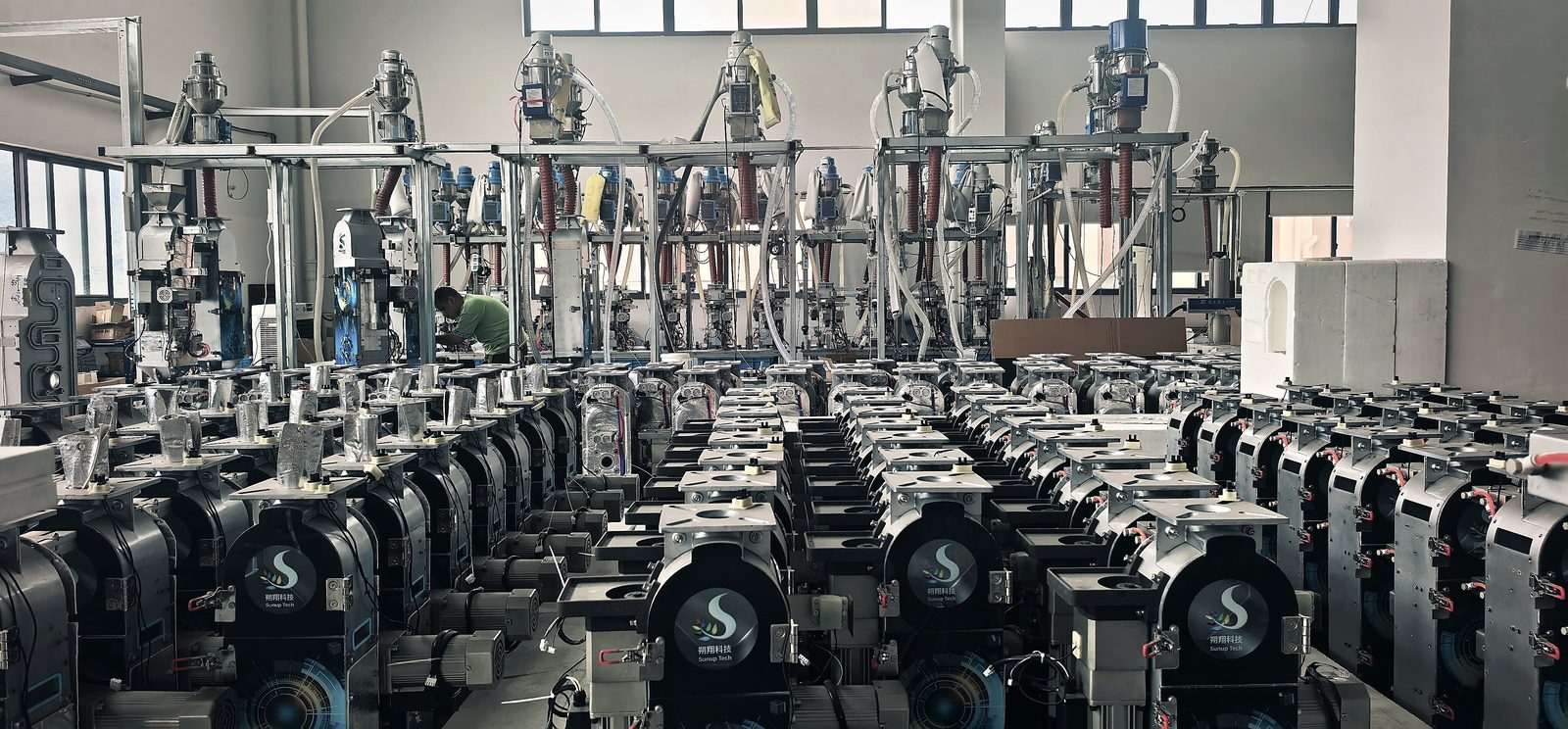
The machines are built by our parent company, Zhejiang Sunup Technology Co., Ltd. (NEEQ: 873579), which also holds the patents. MegaColor is Sunup's color powder dosing machine brand, responsible for sales, development and after-sales. The plant is in Huangyan District, Taizhou, Zhejiang Province, China.
Who makes the parts that matter
The two components that determine dosing consistency — the geared motor and the control system — are both designed and specified in-house by Sunup. They are not generic parts bought in and bolted on. Pneumatics are AIRTAC (Taiwan).
| Component | Brand | Origin |
|---|---|---|
| Geared motor | Sunup's own design | Chinese mainland |
| Control system / PCB | Sunup's own design | Chinese mainland |
| Pneumatic cylinder | AIRTAC | Taiwan, China |
| Solenoid valve | AIRTAC | Taiwan, China |
Designing the motor and controls ourselves pays off in service: when something goes wrong we can trace it back to our own drawings and our own firmware instead of queueing behind an upstream supplier. Spare parts also cannot be discontinued out from under you the way a generic component can.
What changed in the 5th Generation
The four items below are measured whole-machine changes. We do not detail the changes to the metering assembly here — that part is patent and process detail.
| Item | 4th Generation | 5th Generation | Change |
|---|---|---|---|
| Overall height | 840 mm | 684 mm | ↓ 156 mm |
| Net weight | 36 kg | 31 kg | ↓ 5 kg |
| Power, standard model | 220 W | 240 W | ↑ 20 W |
| Packing dimensions | 1000 × 400 × 320 mm | 750 × 480 × 440 mm | Smaller volume |
Shorter and lighter matters because the unit has to fit — and sit securely — in the limited space above an injection moulding machine's hopper. Power went up because the 5th Generation uses a different powder-delivery and mixing structure, not because the same design was driven harder.
How single-dose dosing consistency is measured: take one configuration, dose repeatedly, weigh every dose, and calculate the coefficient of variation (standard deviation ÷ mean). Single-Dose Dosing Consistency (CV): < 0.6% (fine-gear at 100-tooth setting, measured 0.556%). Industry volumetric typical: 3%–5%. The 0.6% figure is our best measured result, not a ceiling that holds at every setting — the full test protocol and raw data are available during technical discussion.
You are welcome to visit the plant
Huangyan, Taizhou. Arrange a time with us in advance. Send your material ahead of the visit and you can review the trial results while you are here.
Downloads: product brochure (PDF), operating manual, installation drawings to be uploaded