
Set & Forget, recipe-driven
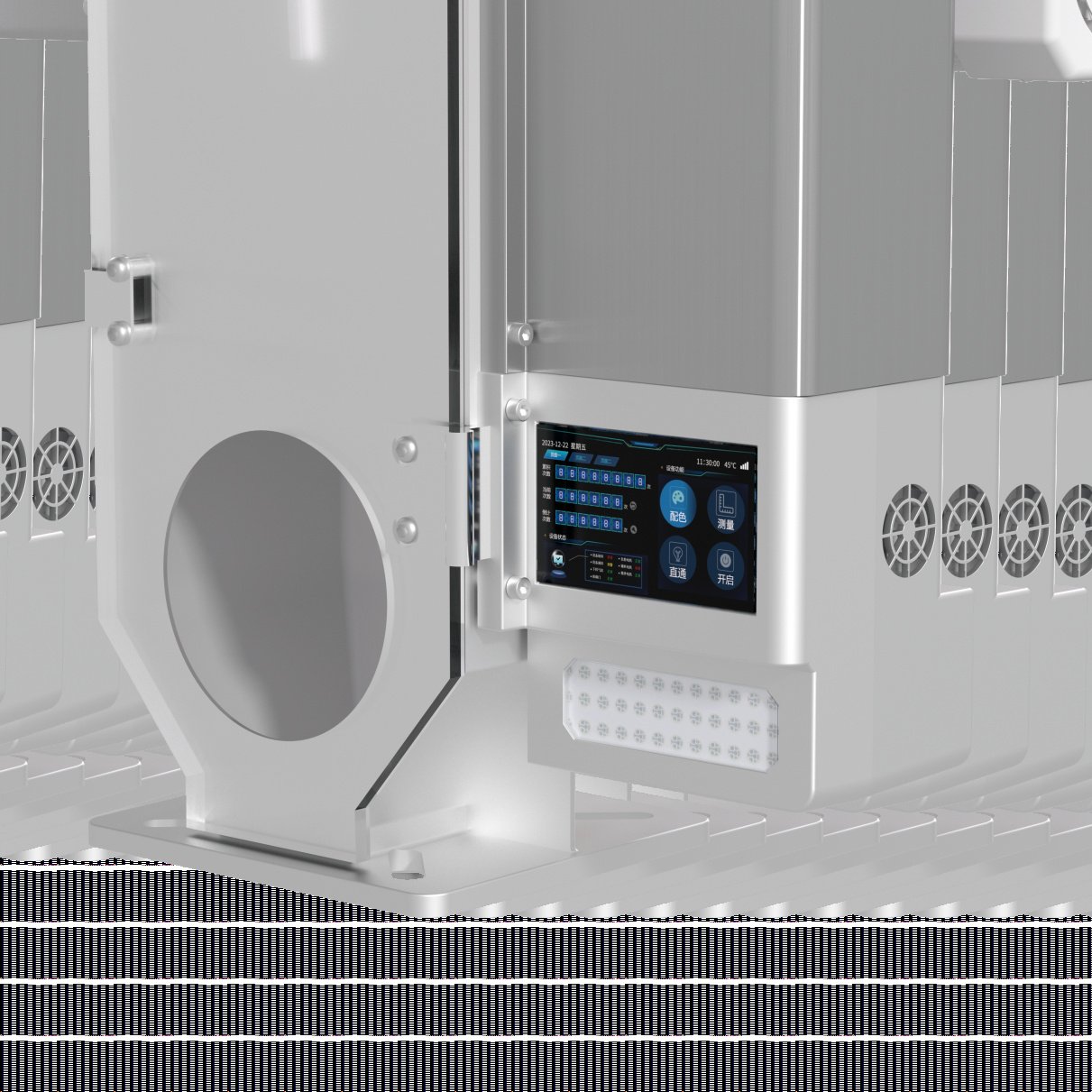
Set the ratio on the screen and press start. The machine then doses and mixes continuously at that ratio with nobody watching it. The operator's job moves from blending powder to purging between colours.
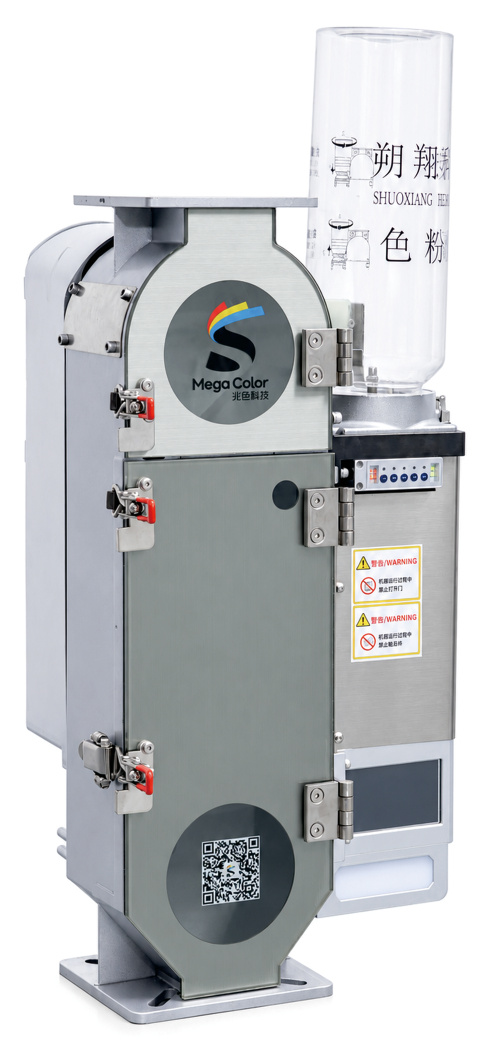
5th Generation · Standard
Mounts above the injection machine hopper and meters color powder into the resin continuously, at the ratio you set. Set it once and it keeps running without an operator watching it — that is the Set & Forget, recipe-driven way of working.
Rather than read the whole spec sheet and guess, start here. If three of these match, this is the model.
Not sure about your resin temperature or throughput? You do not have to work it out yourself. Send us the resin grades and powder you normally run, we will trial on your actual material and talk model selection once there is data — there is no charge for this step.
This section is where the accuracy comes from. Understand this and you will see exactly how we differ from ordinary volumetric equipment.
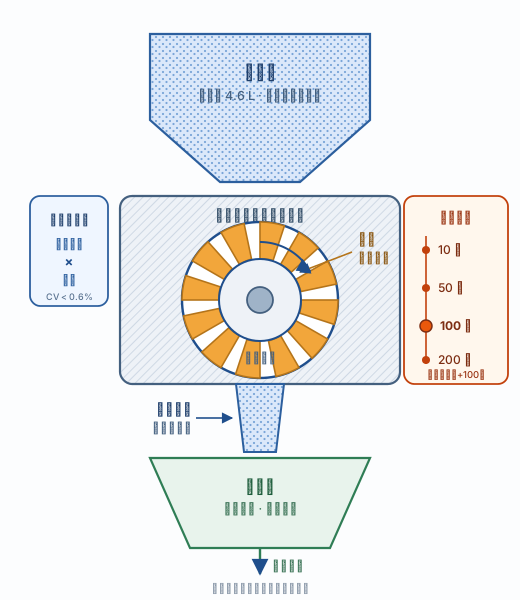
Each cavity on the metering gear holds a fixed volume. However many cavities turn past, that is how many portions of powder are delivered. The "tooth count" you set on the screen means exactly that — 100 teeth delivers twice the powder of 50.
That is fundamentally different from dosing on a timer. With a timer, the delivered quantity shifts as soon as the powder flows differently or the level in the tank rises and falls; cavity volume is unaffected by either.
The powder tank only stores; it takes no part in metering. The standard machine holds 4.6 L. Load what the shift needs rather than filling it. How much is in the tank has no bearing on the size of each dose.
This combination gave the best single-dose consistency in testing (CV 0.556%). Note that these are two separate things: fine-gear is the metering gear specification, 100 is the tooth count you set. Quoting one without the other is incomplete.
Where the loading ratio is unusually low, we recommend adding a dispersing powder so the tooth count can stay at 100 rather than forcing it down to 10 — at very low tooth counts each dose is so small that consistency suffers.
Blank items are pending engineering confirmation. We do not publish them before that.
| Resins | PP / PE / PS / TPE and similar low-temperature resins |
|---|---|
| Throughput | 50–70 kg/h (110–154 lb/h) |
| Single-dose dosing consistency (CV) | < 0.6% (recommended setup: fine-gear at 100 teeth, measured 0.556%) |
| Pigment concentration variation within a batch | < ±0.007% (measured on PP, about 1.3 kg per chamber) |
| Part weight deviation | < 1% |
| Finished-part colour deviation | ΔE < 0.2 |
| Material utilisation | 99.99% |
| Changeover time | 1-minute hopper swap; full purge in under 5 minutes |
| Powder tank capacity | 4.6 L (1.2 US gal) |
| Power | 240 W |
| Overall height | 684 mm (26.9 in) |
| Net weight | 31 kg (68 lb) · gross 33 kg (73 lb) |
| Packing dimensions | 750 × 480 × 440 mm (29.5 × 18.9 × 17.3 in) |
| Fits moulding machine throat | 115 × 115 mm / 4.5 × 4.5 in (throat length × width) |
| Mounting | Replaces the moulding machine's own hopper; 4 bolt holes above and 4 below, adjustable 70–130 mm (2.8–5.1 in) between centres |
| Power supply | AC 220 V, 2P + PE, 50 Hz (single phase) |
| Compressed air | 0.5–0.6 MPa / 73–87 psi (ordinary shop air supply, dry and oil-free) |
What it replaces is the moulding machine's own hopper. The unit sits above the throat of the moulding machine: your material feed connects on top, and the outlet goes straight into the barrel — it is not an extra machine standing next to the hopper. The 115 × 115 mm in the table is the length and width of the moulding machine throat, not the bolt spacing on our machine; it is actually fixed by 4 bolt holes above and 4 below, with adjustable centres (70–130 mm), which matches common machines directly. A slide plate goes in at the bolted joint between the machine and the throat, so you do not have to crane the whole unit off at changeover. If you are unsure, send us a photograph of your hopper and throat and we will check it for you.
A recipe must be tied to a resin grade. The feed chamber is volumetric: the volume is fixed, so the weight of one chamber varies with the bulk density of the resin (about 1.3 kg for PP, about 1.7 kg for PS). Move from PP to PS at the same setting and the pigment quantity has not changed while the resin has got heavier, so the colour comes out visibly lighter. Change resin grade and you re-establish the setting. This is inherent to volumetric dosing. We set up the companion app at handover; you run one test when you change powder, the test data is saved in the app, and setting up after that is quick and straightforward.
Set the ratio on the screen and press start. The machine then doses and mixes continuously at that ratio with nobody watching it. The operator's job moves from blending powder to purging between colours.
Runs color powder and masterbatch. You change a part, not the machine. If you want to move back from masterbatch to powder to bring material cost down, you do not buy a second machine.
Fully sealed mixing chamber — zero dust. Geared metering needs no dispersing oil — zero mineral oil. It mixes only what the machine is about to shoot, so nothing is left over — zero waste.
Some pigments cake. This version is built for them. Choose this configuration if your powder tends to cling to the wall or bridge in the chamber.
Recipes are held in the cloud and can be called up on any machine in any plant. A red you dialled in at one site is pushed to another in one tap. Storage for 200+ colour references.
Six status flags report live: material low, powder motor, discharge cylinder, additive motor, mixing motor, glass door. If any one of them is wrong you see it on your phone. Operating logs and alarm history are both browsable.
On the left is the page for a single machine: three counters (cumulative, current, countdown), the six status flags, and four parameters you can change from the phone directly — mixing time, powder calibration, oil-spray time and additive calibration. On the right is the fleet view: every machine online or offline on one screen, grouped by region.
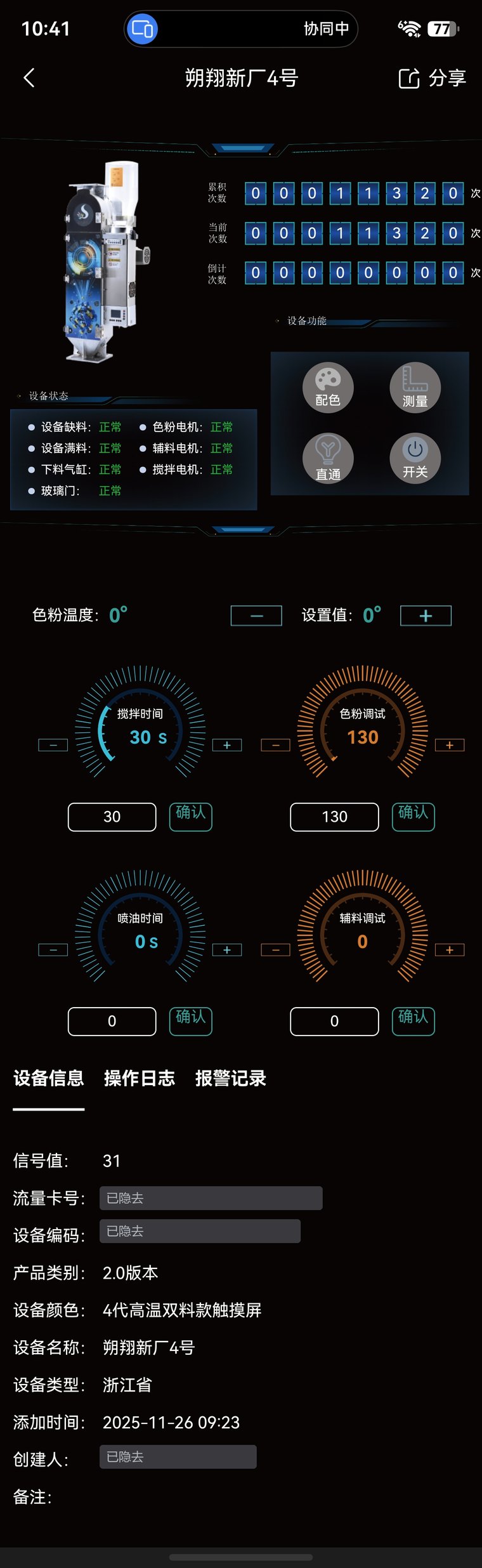
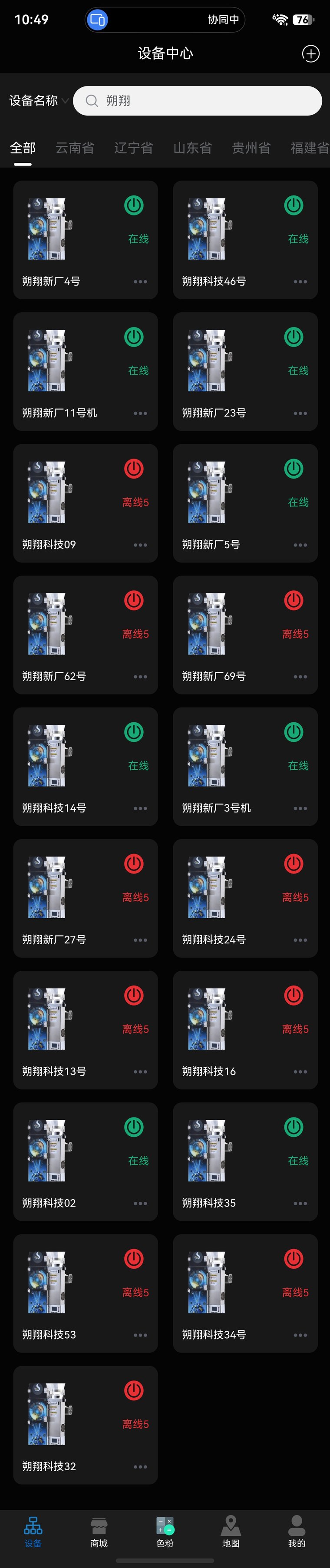
On MES integration: the machine records production data. Which protocol (Modbus / OPC UA / API) and which fields can be exposed has to be confirmed against your particular MES — tell us which system you run and we will put an engineer on it directly.
Within a generation, models differ by resin temperature, throughput and how many materials they feed. If you pick the wrong one we will tell you at the trial stage.
| Model | Generation | Throughput | Feed configuration | Changeover time |
|---|---|---|---|---|
| 5th Gen StandardThis page | 5th Gen · standard | 50–70 kg/h | Single powder | Hopper swap 1 min; full purge under 5 min |
| 5th Gen Dual-Powder | 5th Gen · dual powder | 50–70 kg/h | Two powders | Hopper swap 1 min; full purge under 5 min |
| 5th Gen Dual-Material | 5th Gen · dual material | 50–70 kg/h | Two materials as standard (up to 4 with add-on chambers) | Hopper swap 1 min; full purge under 5 min |
| 4th Gen Standard | 4th Gen · standard | 50–70 kg/h | Single powder + regrind | 10 min (4th Gen level) |
| 4th Gen Dual-Powder | 4th Gen · dual powder | 50–70 kg/h | Two powders + regrind | 10 min (4th Gen level) |
| 4th Gen Dual-Material | 4th Gen · dual material | 50–70 kg/h | Two materials as standard (up to 4 with add-on chambers) | 10 min (4th Gen level) |
| Large Standard | Large frame · standard | 150–180 kg/h | Single powder | 10 min (4th Gen level) |
| Large Dual-Powder | Large frame · dual powder | 150–180 kg/h | Two powders | 10 min (4th Gen level) |
Dual-Powder and Dual-Material are not the same thing.
On the Dual-Powder machine both chambers hold powder — pigment plus a
metallic, or pigment plus a release agent. The Dual-Material machine handles two
resins or fillers (for example resin plus calcium carbonate), for cases
where the bulk densities are far apart, a floor blender cannot hold them together,
and the heavier one settles out as soon as the hopper vibrates.
The difference between 4th and 5th Generation is changeover time (10 minutes
versus 1 minute) and the size of the machine.
Send the resin and pigment you actually run. We test on your own material and send you the data. There is no charge for this.
Downloads: product brochure (PDF), operating manual, installation drawing to be published