
Case study · bottle-cap moulding
Eight blending stations became one inspection round
Monthly colour-deviation rejects fell from 3.2% to 0.02%
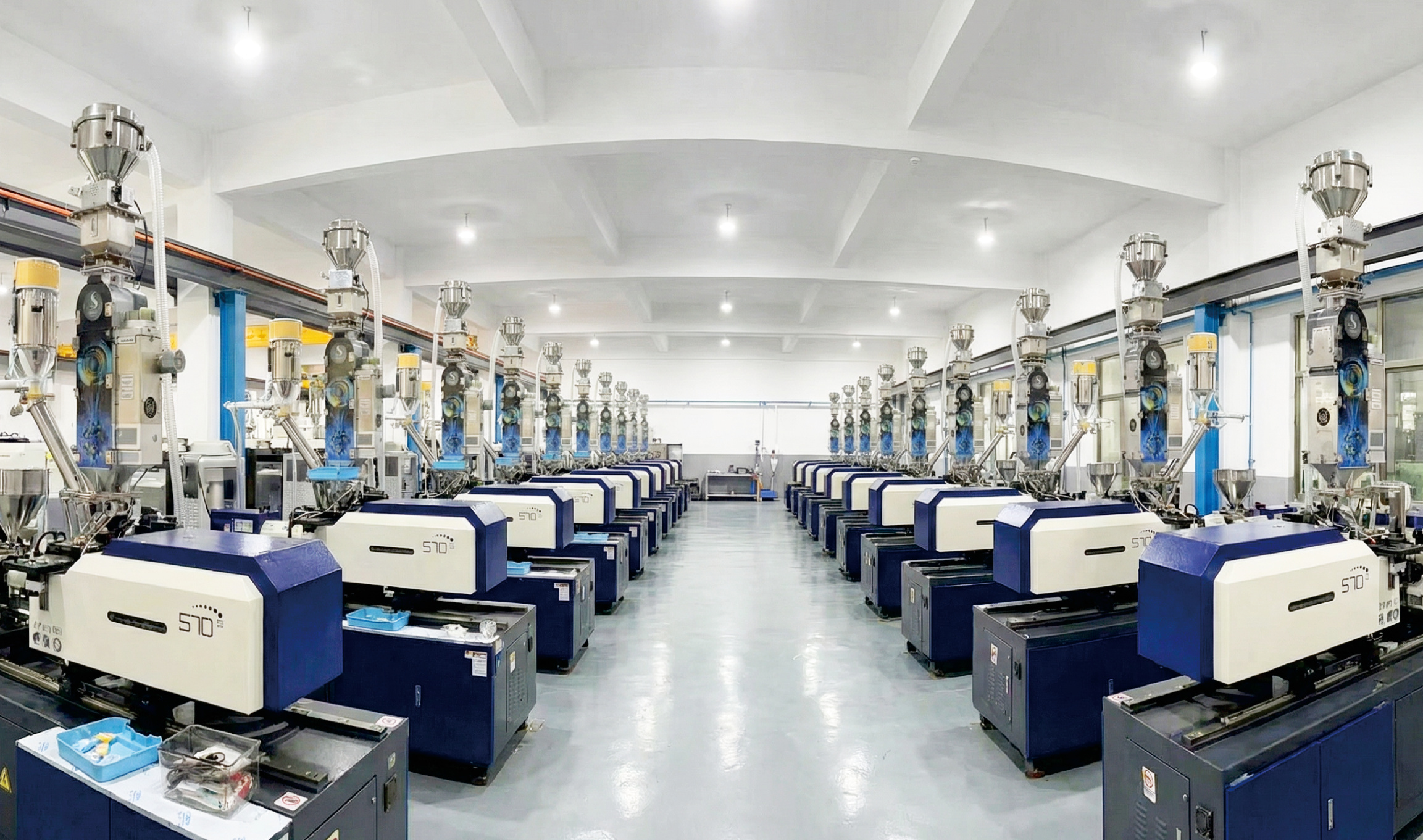
A bottle-cap moulder in Yuyao, Zhejiang, running mainly PP across ◻ injection moulding machines. Pigment used to be blended into the resin by hand in a floor mixer: changeovers were slow and colour varied between batches. With the MegaColor 5th Gen Standard, the blending step needs nobody watching it and those operators moved to purging and changeover.
- 8 → 1Colour blending labour (two shifts → one inspector)
- 3.2% → 0.02%Monthly colour-deviation rejects
- 5 monthsPayback period
Measured three months after commissioning, not projected.
We will not make you a promise out of somebody else’s numbers. The honest way to find out what your plant would save is to send us your material and try it.
What was going wrong before
This section carries only the customer’s own words and observable facts, with nothing inferred.
How it was done
- Pigment and PP combined by eye and tipped into a floor mixer.
- Eight people across two shifts doing nothing but blending.
- A colour change meant cleaning out the mixer and the lines, taking ◻ minutes. (The customer has not supplied a measured before figure; to be added.)
- Blending in the open, with pigment dust through the plant. The blending area took up ◻ m². (To be added.)
The problems in the customer’s own words
- A floor mixer does not blend evenly. Out of one batch, what came out first and what came out last were not the same colour.
- Colour deviation sent whole batches back, averaging 3.2% a month.
- They could not recruit for the blending job, and the wage kept rising.
- Leftover material could only be carried into the next batch, and too much of it threw the colour out again.
Why this is the mixer’s fault and not the operator’s. The conventional method relies on an open vessel to bring pigment and resin together, and such a vessel inherently stratifies and has dead zones. No amount of skill changes what the vessel does. Our approach is not to pre-blend a batch at all but to dose on demand, preparing exactly what each shot needs.
After the retrofit
The figures below are the customer's own count 3 months after commissioning, not projections. We state the basis alongside each one — over what period, on the same product or not, with the same batch of pigment or not. A number without its basis means nothing. Where there are no records to support a line, we leave it blank rather than fill in an estimate.
| Measure | Before | After | Basis |
|---|---|---|---|
| Colour blending labour | 8 people, two shifts | 1 inspector | From the customer's shift roster |
| Monthly colour-deviation rejects | 3.2% | 0.02% | Same cap product, monthly average over the 3 months after commissioning |
| Annual labour saving | — | over RMB 300,000 | Customer's own calculation, social insurance included |
| Payback period | — | 5 months | Customer's finance figure, counting labour and rejects |
| Changeover time | ◻ min | 1 min to swap the hopper / under 5 min for a full purge (5th Generation specification, not measured at this plant) | From stopping to running the next colour |
| Leftover-resin losses | ◻% | ◻% | Material drawn from stores vs finished goods received |
The “after” value on the changeover row is the 5th Generation product specification — the generation must always be stated — not a measurement taken at this plant. On-site measurements are recorded separately; the two are not to be conflated.
Three rules we write case studies by
- Only figures with evidence behind them — shift rosters, QC records, the finance ledger. Nothing from memory.
- Say how a saving was worked out. The “over RMB 300,000 a year” here is the labour line alone, as the customer calculated it; rejects, material and floor space were not folded in to make the number bigger.
- No comparison against competitors — only against this customer's own past.
How it was rolled out
The question every customer asks first is whether production has to stop. This section sets out the timeline as it actually ran.
- 1Send material for a trial
The customer sent the PP grade and the pigment they normally run. We trialled it in our own workshop and issued a trial report.
- 2Start with one machine
We do not ask anyone to convert everything at once. One moulding machine first; roll out once it is proven.
- 3Calibrate the recipe
Tooth settings are calibrated against the customer's actual resin grade. Change the grade and it has to be recalibrated — this step is not optional.
- 4Install across the floor
Once the result is confirmed, one machine per moulding machine. Number of machines and timescale to be confirmed with the customer.
- 5Handover and training
At handover we calibrate every colour on the customer's current order book and store it in the controller. Operators call up a stored recipe; they never work out tooth settings themselves. Training covers purging, changeover and recalling recipes — not watching a screen.
On recipes and resin grades. The feed chamber is volumetric: the volume is fixed, the weight moves with the bulk density of the material. Keep the same setting and switch from PP to PS and the pigment dose has not changed, but the resin going with it is heavier — the colour comes out visibly lighter. A recipe is therefore tied to a resin grade, and when a customer changes material we come back and recalibrate. This is inherent to volumetric metering, not a defect, but it has to be made clear at handover.
Photographs from the floor
Every case needs 3–5 photographs taken on site. Two things to settle before shooting: whether the customer consents to publication, and whether anything is in frame that should not be.
The machine as installed
The moulding hall
The controller screen
A changeover in progress
What not to photograph. The test: photograph what money buys — the building, the machines, the scale of the line. Do not photograph what we know how to do — internal structure, assembly method, critical parameter settings. The first demonstrates capability; the second is technical property. Keep other manufacturers' nameplates out of frame as well.
One trial tells you what your own plant would save
Somebody else's figures are only a reference point. Our advice: send material for a trial, then put one machine in and see.