
PET preforms · Wuhan, Hubei
The same customer ordered three times, from 1 machine to 75
Before and after
This plant makes PET preforms: a high-temperature resin that has to be dried, running at high output. All 75 moulding machines are now fitted. The figures below are this plant’s own.
| Measure | Before | After |
|---|---|---|
| Process sequence | Pigment blended into the PET → both through the dryer → conveyed to the hopper | Only the PET is dried → dried resin enters the mixing chamber → pigment is added there and goes straight into production |
| Colour after drying | Came out lighter once dried | The pigment never sees the dryer, so the step does not exist |
| Conveying | Pigment carried off into the air during conveying; each batch paler than the last | Mixed and fed straight into the barrel, with no conveying step to lose pigment in |
| Blending station | Staffed continuously, guarding against both mistakes and falling behind | Set once, then left alone |
| Blending operators | 12 | 3 — two on days, one on nights |
| Scrap rate | Peaked at 21% | Effectively none |
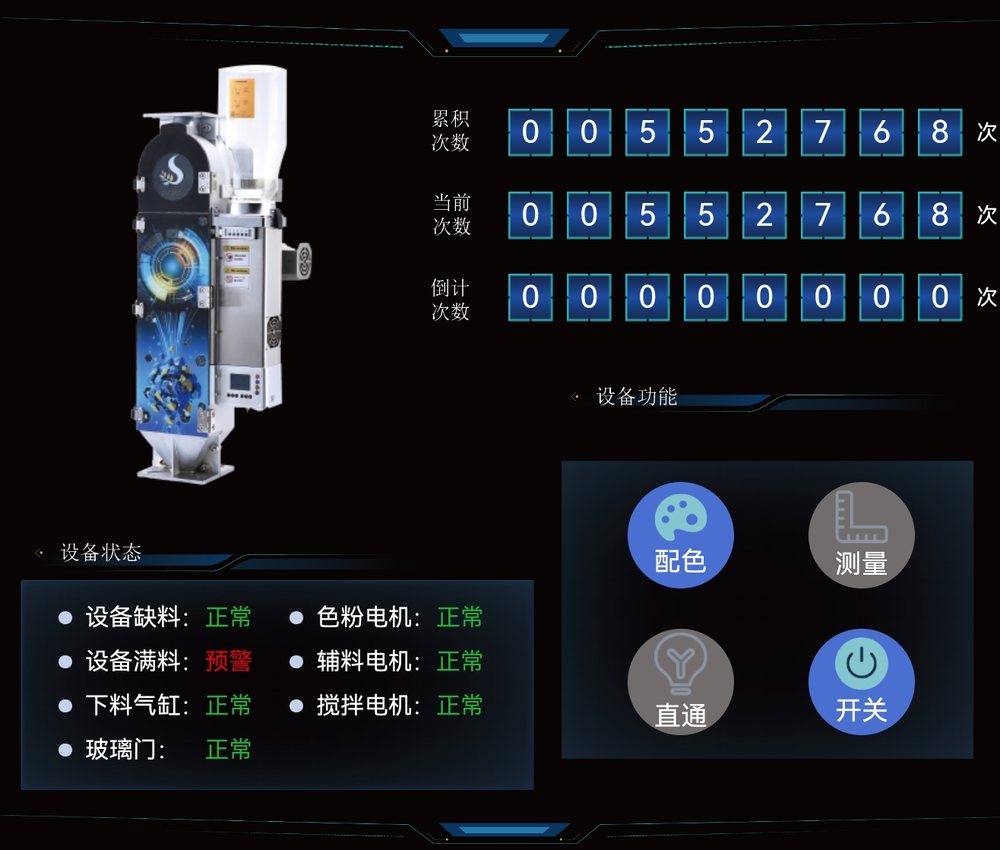
| Maintenance | — | The first machine has run 550,000 doses with no parts replaced and no servicing |
| Item | Doses | PET equivalent |
|---|---|---|
| First machine, cumulative (Oct 2024 to date) | 550,000 | about 1,150 t |
| Average per machine per year | 240,000 | about 500 t |
| All 75 machines per year | about 18 million | about 38,000 t |
The dose count is the hard figure; the tonnage is derived. The dose count comes from the machine’s own counter. The tonnage assumes about 2.1 kg of PET per dose: the chamber is volumetric, with a fixed volume of about 2.54 litres, so what it weighs depends on the bulk density of the material. That 2.1 kg comes from taking bottle-grade PET chip at 0.85. Different grades and chip sizes will shift it, so treat the tonnage as an order of magnitude, not a precise figure.
How to read the scrap rate. The 21% was this plant’s worst point before the retrofit, not a normal average; afterwards the customer’s own phrase was “effectively none”. We do not quote this as a percentage improvement, because scrap depends on tooling, material and process window as well — colour dosing alone does not determine it.
How it happened
This plant makes PET preforms at high output and very high daily volume. A dozen people were on blending and never off their feet — it is hard physical work with no room for error, since one wrong batch is scrapped, and if blending falls behind the presses wait. People did not stay long and turnover would not come down.
The worse problem was not labour, it was colour. PET is a high-temperature resin and has to be dried. Their practice was to blend the pigment into the PET first, send both through the dryer, then convey the mix up to the press hopper. That goes wrong in two places. Drying lightens the colour. And during conveying the air stream carries pigment off into the plant, so there is less of it left in the material and each batch comes out paler than the one before. At its worst the scrap rate reached 21%.
On 15 October 2024 they bought one machine to try. Their reasoning was straightforward: the problem was acute and they were out of options, so buy one, see whether it fixes anything, and in the meantime find out whether the machine and the support behind it hold up.
Our engineer went out to commission it and, having seen the floor, changed the order of operations: stop colouring first. Dry the PET on its own; the dried resin goes into our mixing chamber, and only then does the dosing system deliver pigment into that chamber, where it mixes with the dried PET and goes straight into the barrel. The pigment never passes through the dryer or the conveyor. Colour loss in drying and pigment carry-off in conveying are not suppressed by tuning parameters — the process no longer contains the steps that caused them.
On top of that, the machine needs nobody once it is set. Colour held steady, the machines ran steadily, and the blending job no longer needed bodies thrown at it.
In March 2025 they ordered 21 more. In June 2025 all 75 moulding machines went live. That is where the three orders come from: the first was a trial, the other two were worked out on paper.
On support: every customer gets a dedicated group chat that includes our chairman, chief engineer, after-sales manager and the engineer on the account, so questions are answered more or less immediately. When a site visit is needed it is a 12-hour trip from Zhejiang. The machine itself needs almost no servicing and has virtually no consumable parts on a replacement schedule — the one installed in October 2024 has run 550,000 doses without a single part changed.
We were out of options, so we thought we would buy one and see whether it solved anything — and find out whether your support and your machine hold up.
We used to dry the pigment along with the resin, and it came out lighter. Then conveying took some of the pigment away as well, so each batch was paler than the last. Now we dry only the resin and the pigment goes in at the chamber. The problem is gone at the root.
Once it is set you leave it. We had a dozen people on blending who could not keep up and still worried about getting it wrong. Now it is two on days and one on nights.
The machine we installed in October 2024 has run 550,000 doses and we have not changed a single part. Ask a question in the group and someone answers; if we need someone on site they can be here in twelve hours.
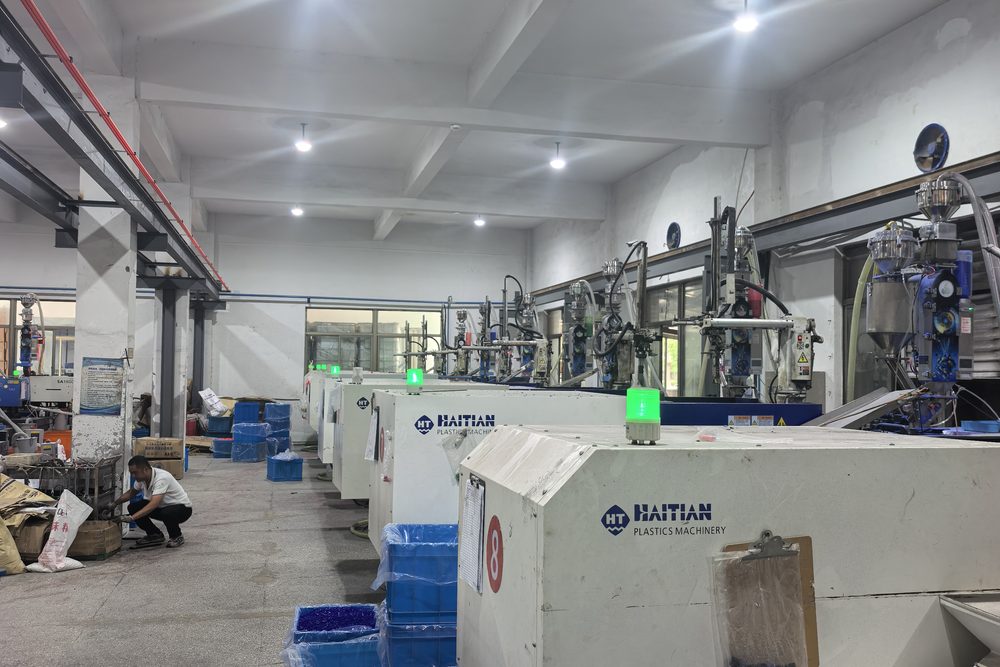
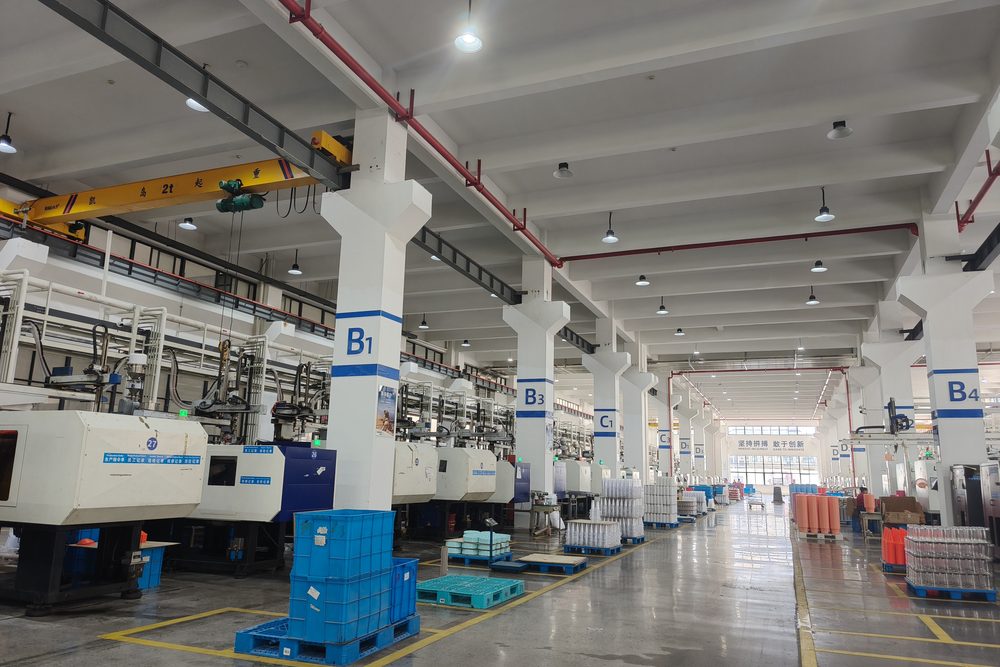
Photographs from the floor
Photographs from customer plants. At their request these show the equipment and the work station only — no company names, signage or anything that identifies the site.
Who this case applies to
Close enough to read across directly
- PET preform moulders, and anyone on a high-temperature resin that has to be dried
- Anyone currently colouring first, then drying, then conveying
- Colour fading batch by batch with no identified cause
- High output with a dozen people on blending who still cannot keep up
- Plants a long way from our base, worried that support will not reach them
- Anyone who wants to run one machine first and roll out once it is proven
Different enough that you should not read the figures across
- Resins that need no drying — the process gain here does not apply to you
- To see what replacing hand blending saves, read the bottle-cap moulder in Yuyao
- For the full three-part cost breakdown, read the moulder in Linhai
- For what we commit to on support, see Support
Do not treat somebody else’s numbers as your forecast. Scrap rate, headcount and dosing volume all follow from what you make, which resin you run, your shift pattern and how the process was arranged before. Most of what this plant gained came from getting the sequence right — which only matters because their material has to be dried. If yours does not, that gain is not available to you. To get your own figure, tell us your machine count, your shift pattern and your resin, or send material for a trial.
Want to know how it runs on your material?
Somebody else’s case is a reference point; the data from your own material is what you can decide on. Send it to us for a trial run — there is no charge for this.
For a trial we need the resin grade, the pigment reference and the let-down ratio. Results normally come back within 3 working days.