
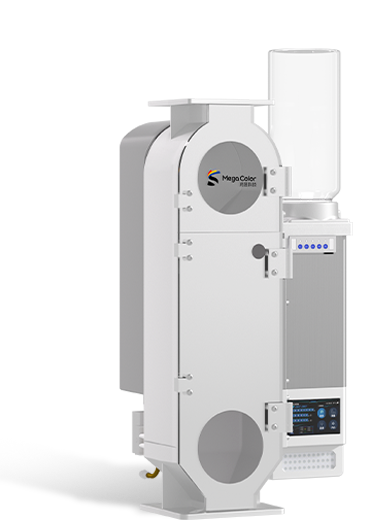
Best seller · 5th Generation
5th Gen Standard
Low-temp resins · 50–70 kg/h · single powder
- 1-minute hopper swap, full purge under 5 minutes
- Anti-stick mineral-oil spray for powders prone to caking
- DualMode™ runs color powder and masterbatch
The company that created the color powder dosing machine category
MegaColor intelligent color powder dosing machines meter powder into resin
continuously at the ratio you set — set the recipe once and leave it.
Single-dose dosing consistency CV < 0.6%. Fully sealed: zero airborne dust,
zero mineral oil, zero waste.
Part of Sunup Group · NEEQ-listed 873579 · 20 patents in force (itemised list available)
On the left is what happens on the floor every day. On the right is how we do it. No concepts — just the structural difference.
Four questions and you get a model number. If you are unsure, pick “both” — we will work it out from your actual material list.
① Which resins do you run?
② Throughput per machine?
③ Do you need to dose two resins at once?
④ Do you need to dose two powders at once?
Answer all four and your recommended model appears here.
Metering does not rely on sensor feedback. It relies on the physical volume of a gear cavity. The structure sets the floor, and that is the fundamental difference from an ordinary volumetric feeder.
4.6 L on standard machines, 10.5 L on large-capacity. The tank only stores — it takes no part in metering. Load what the shift needs; it does not have to be full, and how much sits in the tank has no bearing on the size of each dose.
Dose = gear cavity volume × tooth count. That is where the 50 / 100 / 200 settings come from. On the recommended setup (fine-gear at the 100-tooth setting) single-dose dosing consistency measures 0.556%; the published figure is CV < 0.6%.
The feed chamber is volumetric, with a fixed chamber volume. Measured on PP, one chamber holds roughly 1.3 kg, and powder concentration varies by less than ±0.007% within a batch.
Blending happens inside the sealed chamber — no mineral oil, no airborne dust. Nothing is left in the chamber when a batch finishes, so there is no leftover to throw away.
Mounted above the injection machine feed throat, dosing as the machine shoots. Set the recipe once and it runs continuously without an operator watching it.
One important note about volumetric dosing: a recipe is only valid for the resin grade it was set on. Keep the same setting and switch from PP to PS and the powder dose is unchanged while the resin is heavier, so the colour comes out visibly lighter. That is inherent to volumetric dosing, not a defect. At handover we set up the companion app for you: run one test each time you change powder, the results are stored in the app, and resetting is quick and straightforward.
Three axes: throughput, two resins, two powders. High-temperature resins do not get a separate machine — the same machine is ordered in a high-temp configuration (model suffix -S). It looks identical from the outside; what differs is the heat-resistant internals.
Two resins and two powders are different problems: the Dual-Material model handles two resins (resin plus calcium carbonate, for instance) whose bulk densities are too far apart to blend evenly. The Dual-Powder model handles two powders (color powder plus metallic pigment, or powder plus release agent) that both need dosing to ratio at the same time.
Best seller · 5th Generation
Low-temp resins · 50–70 kg/h · single powder
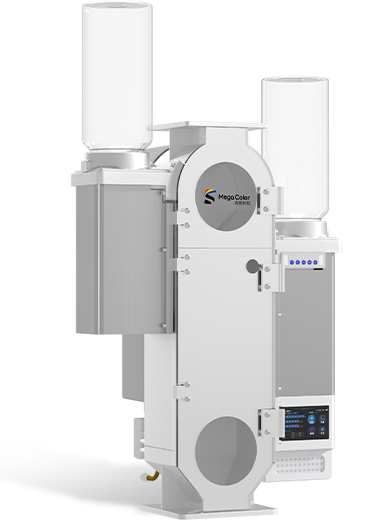
5th Generation
Low-temp resins · 50–70 kg/h · two powders
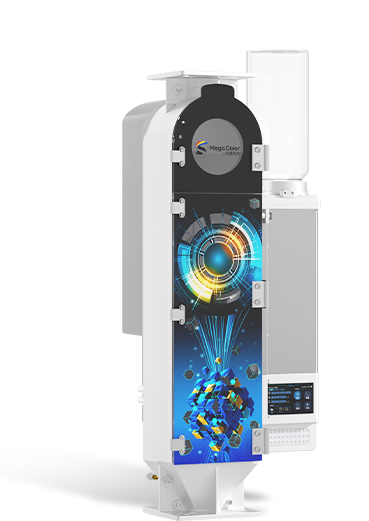
4th Generation
Low-temp resins · 50–70 kg/h · regrind capable
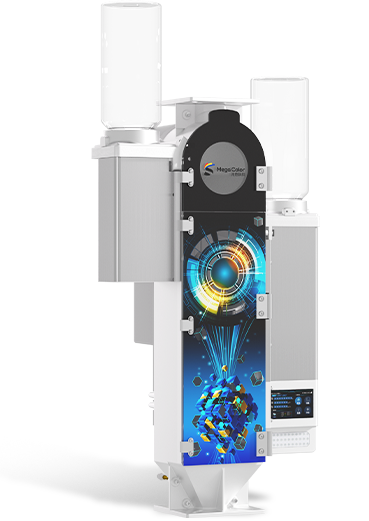
4th Generation
Low-temp resins · 50–70 kg/h · two powders + regrind
| Model | Generation | Throughput | Dosing configuration | Changeover | Powder tank |
|---|---|---|---|---|---|
| 5th Gen Standard | 5th Generation | 50–70 kg/h | Single powder | 1-min hopper swap / purge under 5 min | 4.6 L |
| 5th Gen Dual-Powder | 5th Generation | 50–70 kg/h | Two powders | 1-min hopper swap / purge under 5 min | 4.6 L |
| 5th Gen Dual-Material | 5th Generation | 50–70 kg/h | Two resins as standard (up to 4 with add-ons) | 1-min hopper swap / purge under 5 min | 4.6 L |
| 4th Gen Standard | 4th Generation | 50–70 kg/h | Single powder + regrind | 10 min | 4.6 L |
| 4th Gen Dual-Powder | 4th Generation | 50–70 kg/h | Two powders + regrind | 10 min | 4.6 L |
| 4th Gen Dual-Material | 4th Generation | 50–70 kg/h | Two resins as standard (up to 4 with add-ons) | 10 min | 4.6 L |
| Large-Capacity Standard | Large-capacity | 150–180 kg/h | Single powder | 10 min | 10.5 L |
| Large-Capacity Dual-Powder | Large-capacity | 150–180 kg/h | Two powders | 10 min | 10.5 L |
Dual-Powder and Dual-Material are not the same machine, and the two are easy to confuse. On a Dual-Powder machine both tanks hold powder — color powder with metallic pigment, or color powder with release agent, both of which customers run today. A Dual-Material machine handles multiple resins, such as resin with calcium carbonate, where the bulk densities are far enough apart that a tumbler will not blend them evenly and one settles out as soon as the hopper vibrates. The wrong machine will not fix the problem once it is installed, so if you are unsure, send us your material list.
The figures come from the customer's own records three months after commissioning. We identify customer plants by city and industry only.
Bottle caps · Yuyao, Zhejiang
This plant used to blend colour by hand in a tumbler. The problem was never the operators' consistency — it was the vessel. Powder is never evenly distributed through a tumbler load, so caps from the same batch came out in noticeably different shades.
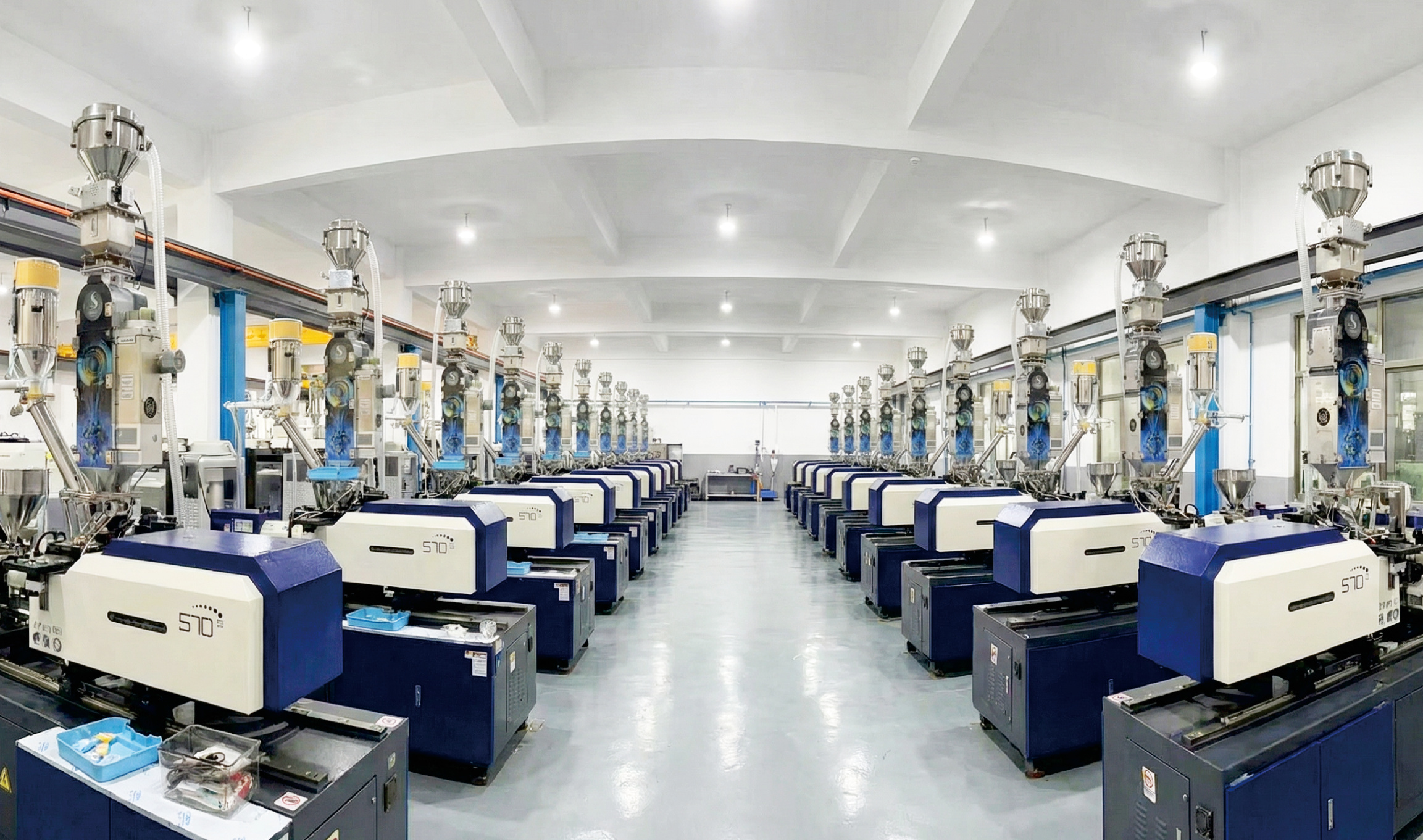
About these figures: they come from the customer's own records three months after commissioning, not from a projection. We identify customer plants by city and industry only, and we do not resort to hints like “a well-known brand”. The other cases in progress — a customer now on their third repeat order, a changeover trial in home appliances, and colour matching on export parts — will be published to the same structure: previous process, specific problem, model selected, implementation timeline, before-and-after comparison, and photographs from the floor.
A wall of certificate photographs convinces nobody. What follows is what each piece of technology actually solves.
Each dose is fixed by the metering gear — cavity volume × tooth count — not by a timer and not by an operator's judgement. That is where the 10 / 50 / 100 / 200-tooth settings come from.
The powder tank only stores; it takes no part in metering. Load what the shift needs rather than filling it, because the quantity in the tank has no bearing on the size of each dose.
Powder and resin are blended inside a closed chamber. Against an open tumbler, that means dust stays contained, and no dispersing oil is needed to make the powder adhere.
This is the structural source of two of the Three Zeros: zero airborne dust and zero mineral oil.
Material is fed to recipe ratio on demand, and nothing remains in the chamber when a batch ends. Neither of the two usual losses applies: surplus set aside, and leftover carried into the next batch.
This is the basis of the 99.99% material utilisation figure — it refers to leftover loss. A dose count can also be set for automatic stop: work out how many doses an order needs, enter it, and the machine stops when it gets there, so in principle no batch is over-mixed.
Every figure is published with its test conditions. A specification without stated conditions is one you cannot compare against anyone else.
| Metric | MegaColor | Definition / test conditions | Industry comparison |
|---|---|---|---|
| Single-Dose Dosing Consistency (CV) | < 0.6% | Repeated doses of the same powder on the same gear at the same setting, each weighed. CV = standard deviation ÷ mean. Measured 0.556% on the recommended setup (fine-gear at the 100-tooth setting). | Typical volumetric: 3%–5% |
| Powder concentration variation within a batch | < ±0.007% | Calculated on 1.3 kg of PP per batch. PP / PE is the worst case, so this is an upper bound. | Manual blending: > ±0.2% |
| Part weight accuracy | < 1% | Variation in finished part weight. Consistent dosing is the cause; consistent weight is the result. | Common in industry: > 5% |
| Colour deviation | ΔE < 0.2 | CIE L*a*b* formula, D65 illuminant, measured with a spectrophotometer. | Pass line for decorative parts: ΔE ≤ 1.0 |
| Material utilisation | 99.99% | Refers to leftover loss: dosed to recipe as the machine shoots, nothing left in the chamber. | Manual blending loses 1.5% or more |
| Changeover time | 1 minute | 5th Generation: 1-minute hopper swap, full purge under 5 minutes. 4th Generation: 10 minutes. | Manual blending to a light colour: > 60 minutes |
The patent list has its own page. Our parent company, Zhejiang Sunup Technology Co., Ltd., holds 20 patents in force covering color powder dosing machines (2 invention patents + 18 utility models). Every title and application number is listed, so you can verify each one against the CNIPA register yourself — view the patent list.
Once the machine is connected, you can see the running state of any single machine and which machines across the plant are online. Four parameters — blending time, powder calibration, oil spray timing and additive calibration — can be changed from the phone.
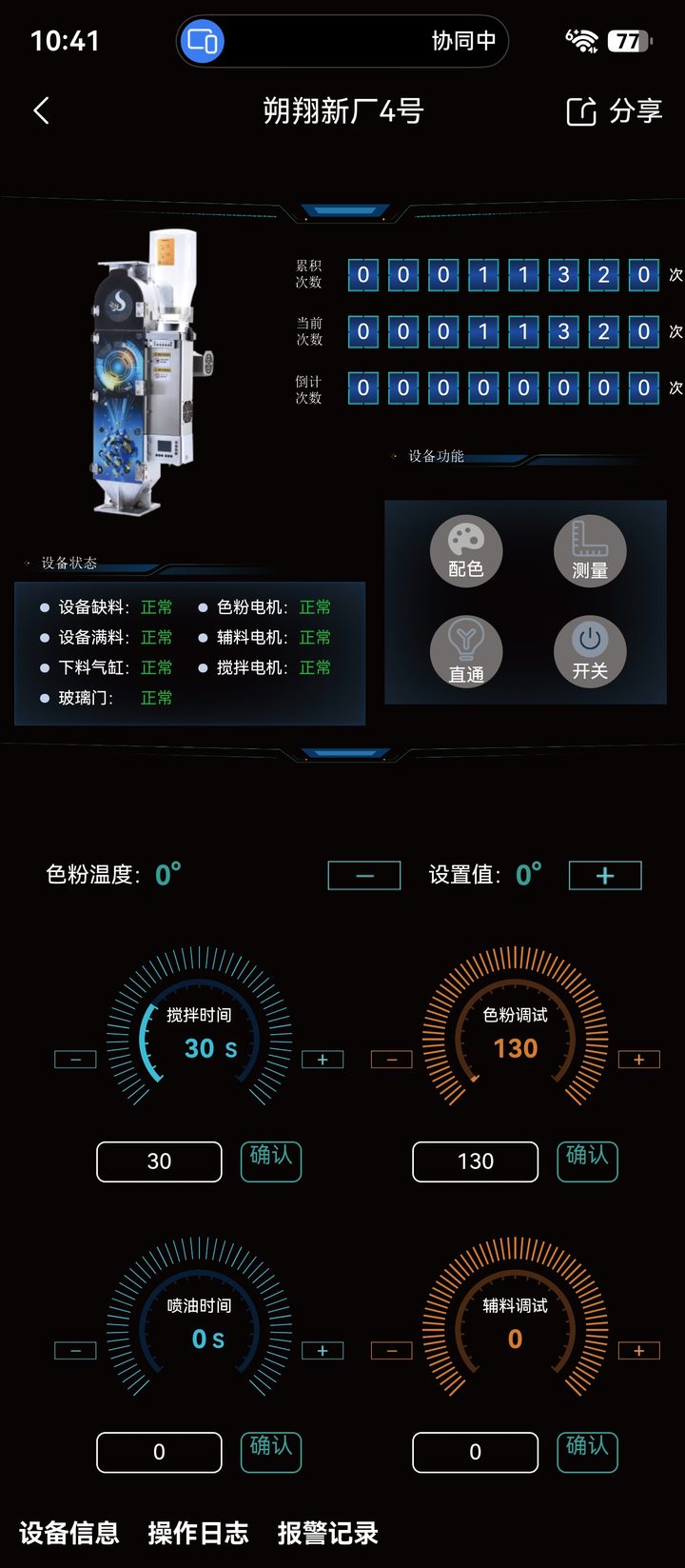
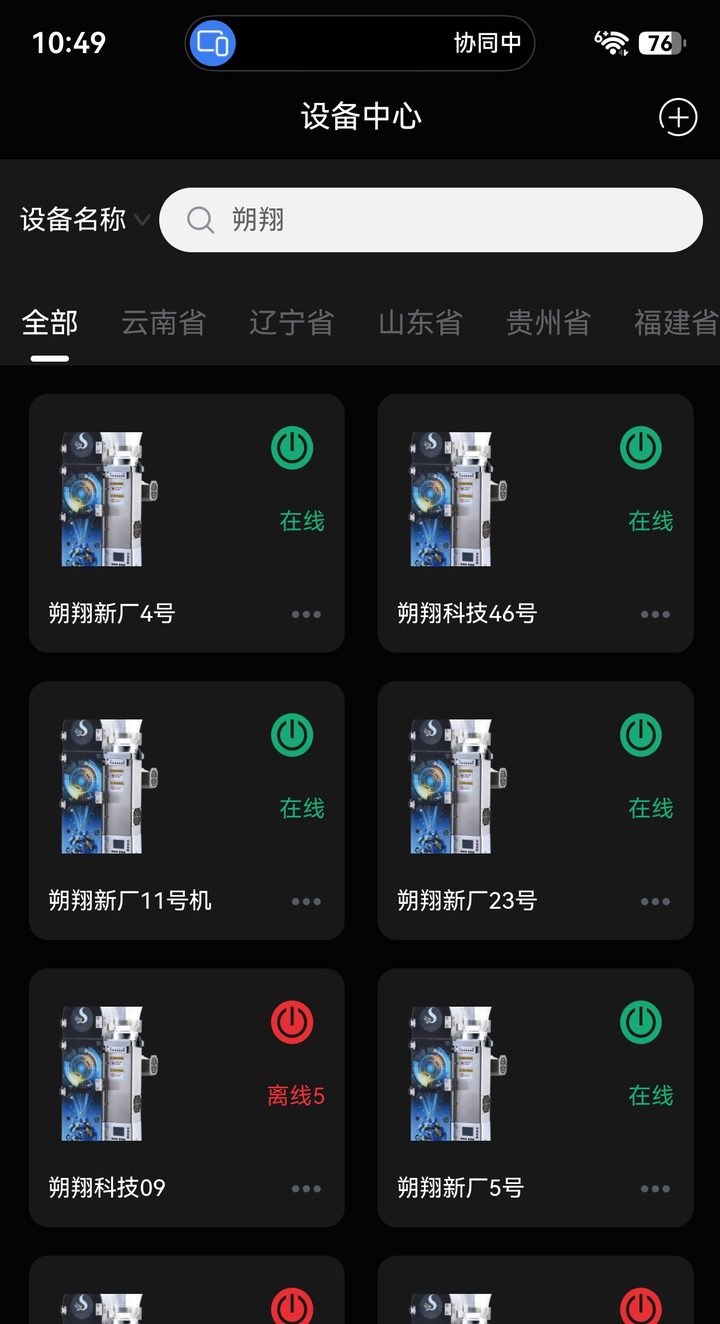
The geared motors and the control system are developed in-house by the group, not assembled from off-the-shelf parts.
| Geared motor | Built to Sunup's specification (not an off-the-shelf part) |
|---|---|
| Control system / PCB | Developed in-house by Sunup (not a bought-in PLC) |
| Cylinders / solenoid valves | AIRTAC (Taiwan, China) |
| Manufacturing base | 20,000 m² |
|---|---|
| Monthly capacity | 2,000 units |
| Team | 300+ across R&D, production and sales |
| Cumulative R&D spend | RMB 10 million |
| Accreditations | National High-Tech Enterprise · Zhejiang Province “Specialised, Refined, Distinctive and Innovative” SME · Zhejiang Provincial Industrial New Product (2025) |
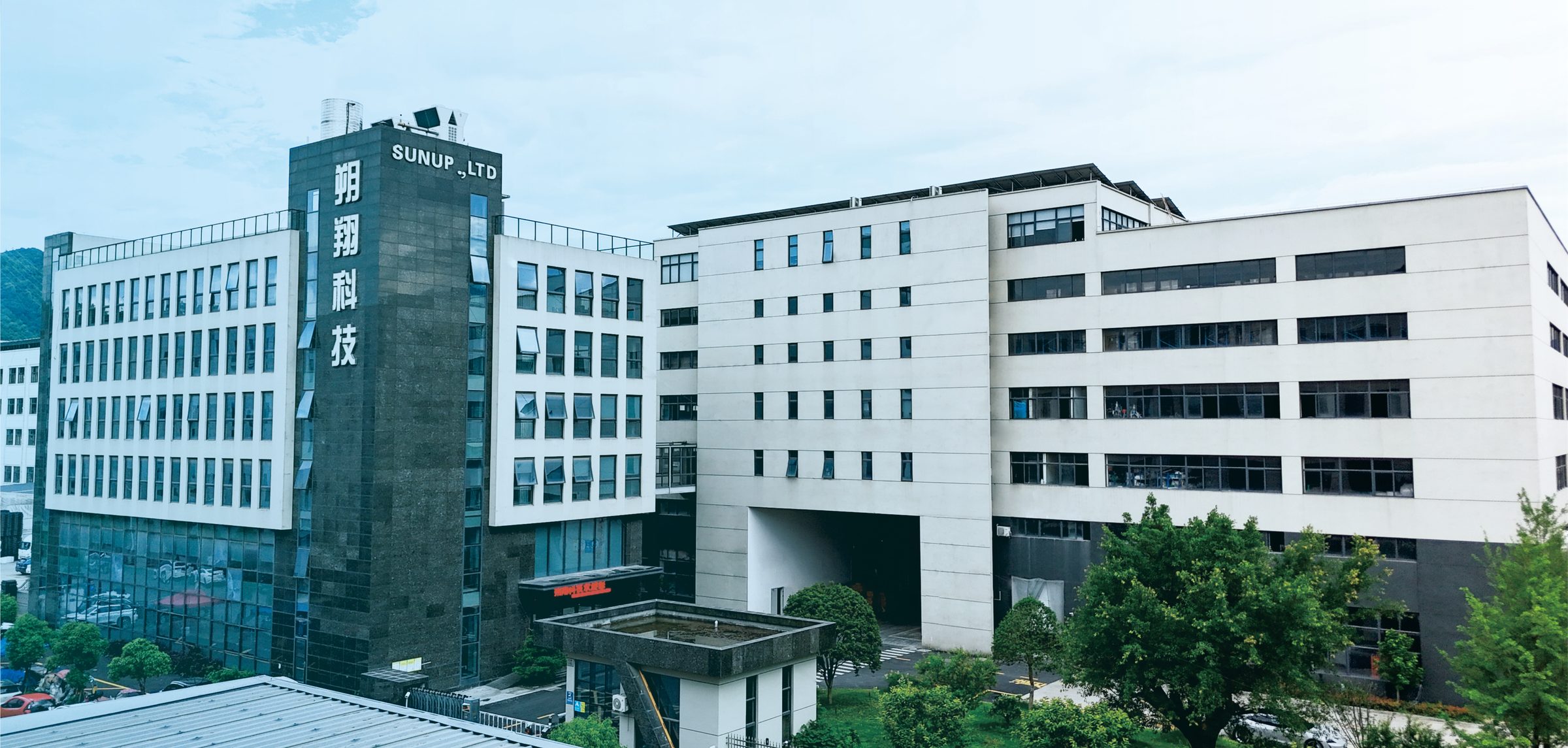
The warranty terms are at the end. First, what we do.
| Location | Where | Primary coverage |
|---|---|---|
| Headquarters | Huangyan, Taizhou, Zhejiang | Plant, spare parts warehouse, technical centre |
| Yuyao service centre | Yuyao, Zhejiang | Ningbo and Shaoxing area |
| Dongguan service centre | Dongguan, Guangdong | Pearl River Delta |
These are our service centres in China. Outside China, support runs on remote diagnosis in English plus air-freighted spare parts, and we will train your own maintenance staff during commissioning. Regional service partners are being appointed — tell us where you are and we will set out in writing what we can commit to for your location.
1. Warranty period and start date
The machine carries a 12-month warranty from the date of acceptance, evidenced by
the installation acceptance record or the signed sales contract. Faults or failures
caused by the product's own quality within the warranty period are repaired or
replaced free of charge.
2. What is not covered
The following are not product quality faults and fall outside free warranty
coverage, although we still provide paid service for them at our out-of-warranty
rates:
Repair charges for accidental damage and force majeure are payable in full, without reduction.
3. Out-of-warranty charging
Repairs outside the warranty period follow the MegaColor After-Sales Charging
Schedule: a base service fee per visit, spare parts at list price, travel and
accommodation for out-of-area visits at cost, and a premium for expedited response.
If you supply the parts yourself we charge only the base service fee — but if a
part you supplied fails and causes a second repair, that repair is charged afresh.
Repair work itself carries a 3-month warranty. Two tiers of maintenance package
(basic and upgraded) are also available, covering scheduled inspections, unlimited
remote support and a set number of free on-site visits; these packages are currently
limited to Zhejiang Province and are non-transferable.
Exact amounts, package contents and scope are in the schedule, available from
sales or after-sales on request.
4. Other
If you dispute a charge, raise it after you receive the cost breakdown and we will
respond within the agreed time. Any change to the charging schedule will be notified
in writing in advance. The above is our current after-sales position; for a specific
project the signed sales contract and the After-Sales Charging Schedule prevail.
Run it on your own shop floor numbers. We do not assume your output or your wage rates for you.
The panel on the right works from the figures you enter.
Already running a masterbatch dosing machine? Switch to the second option — that one compares material cost only, with no blending labour, because you do not have a blending station to begin with.
Five questions, about a minute. We reply within 24 hours (Beijing Time, Mon–Fri).