
Appliance moulding · Ningbo, Zhejiang
If you cannot hire a blending operator, remove the job
Before and after
What this customer said in their own words tells you more than the figures do — their problem was hiring, not process.
| Measure | Before | After |
|---|---|---|
| Colour blending role | Hard to fill, harder to keep filled | No dedicated operator needed |
| Changeover time | Drums cleaned out by hand; slow | 10 minutes (4th Generation at the time) |
| Working conditions | “Really bad” | Fully sealed; far easier on the operators |
| Nature of the job | Standing in pigment dust, blending | Changeover, purging and inspection |
| Labour and cost figures | — | Not released by the customer |
The 10 minutes here is 4th Generation performance. This customer installed the 4th Generation at the time. The 5th Generation has a swappable hopper: 1 minute to swap, under 5 minutes for a full purge. New installations should be costed on 5th Generation figures. We do not apply 5th Generation numbers to a 4th Generation case.
How it happened
When this customer first came to us, the first thing they raised was not accuracy, it was recruitment. The blending job is dusty and physical, it is hard to fill, and the people they did hire did not stay. Every time an experienced operator left, the colour went unstable again — the knack walks out of the door with the person.
Appliance housings are judged closely on surface finish and colour, and a batch outside tolerance is reworked in full. Depending on an individual operator means betting product quality on whether one experienced hand decides to resign.
The approach was not to make the blending job faster, it was to remove the job. The recipe is held in the machine and the pigment is dosed to that ratio automatically, so the quantity is the same whoever is on shift. The operator who had been blending moved to changeover, purging and inspection — cleaner work and less of a physical load.
In their own words: “The blending job used to be hard to fill and harder to keep filled, and conditions on that station were really bad. Now we do not need a dedicated blending operator at all, a changeover is done in 10 minutes, and the job is far easier on the people doing it.” We quote this often, because it answers hiring, retention and working conditions in one breath.
The blending job used to be hard to fill and harder to keep filled, and conditions on that station were really bad. Now we do not need a dedicated blending operator at all, a changeover is done in 10 minutes, and the job is far easier on the people doing it.
Photographs from the floor
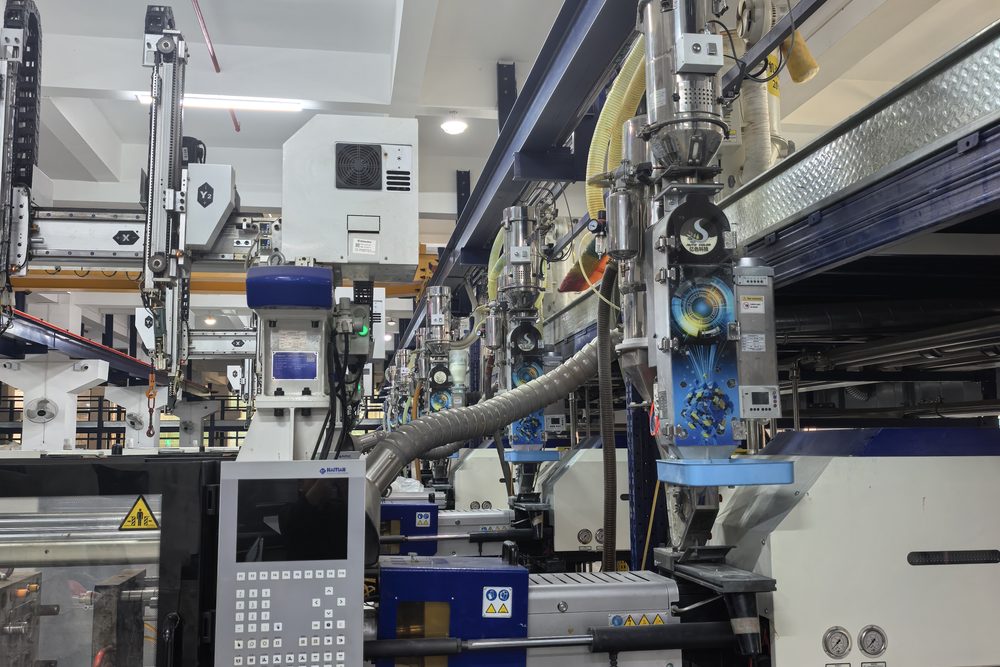
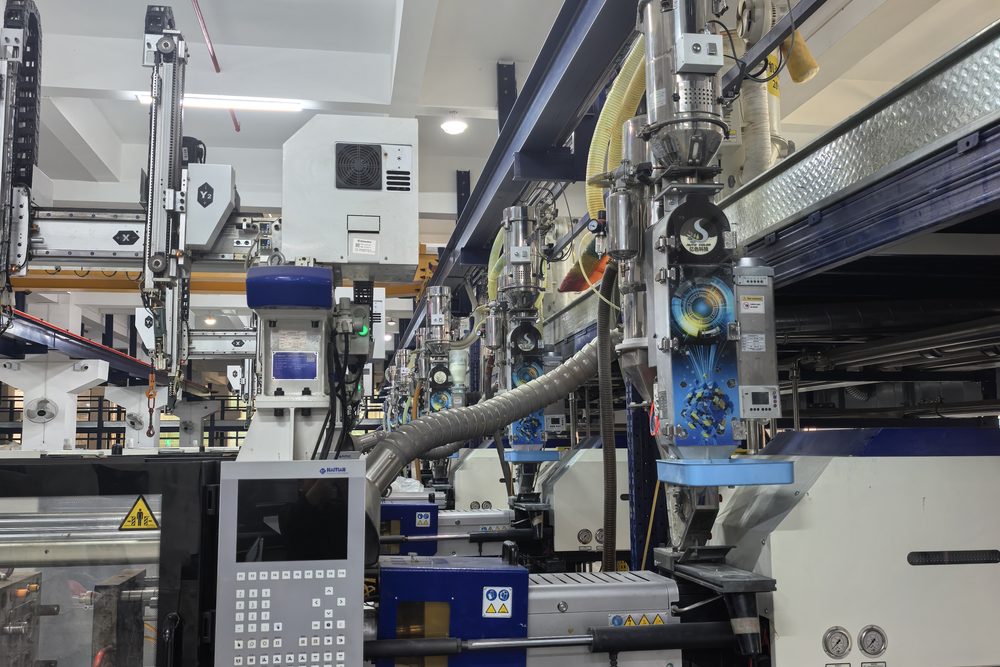
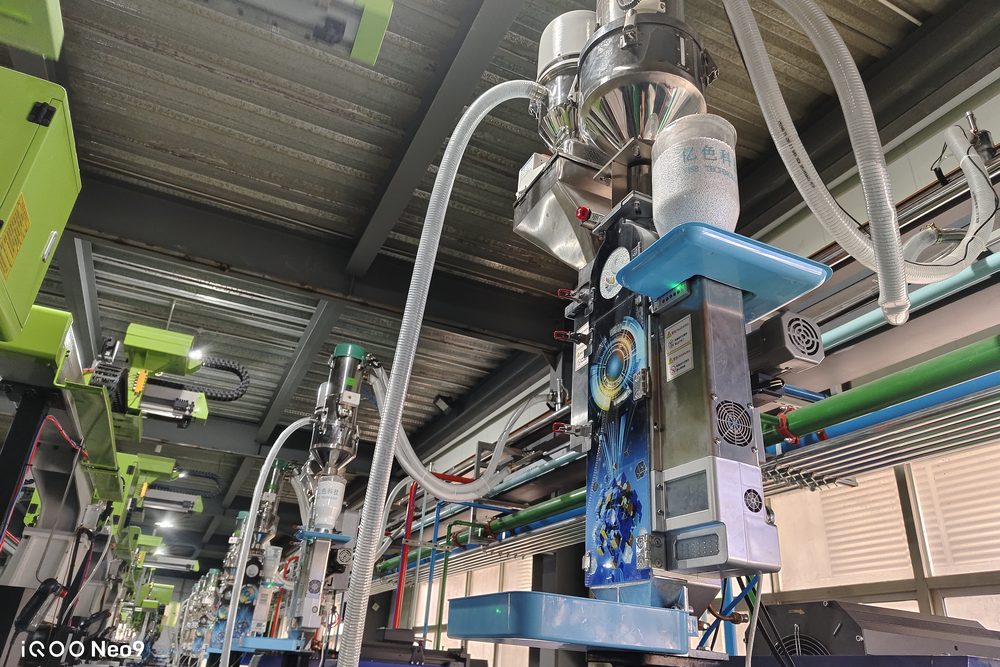
Photographs from customer plants. At their request these show the equipment and the work station only — no company names, signage or anything that identifies the site.
Who this case applies to
Close enough to read across directly
- Blending and material-handling roles you cannot fill or cannot keep filled
- Parts judged closely on surface finish and colour, such as appliance housings
- Colour consistency that currently rests on two or three experienced operators
- Frequent colour changes, with cleaning out and changing over eating machine hours
Different enough that you should not read the figures across
- Long runs in a single colour with almost no changeovers — the changeover gain does not apply
- For the 1-minute changeover, see the 5th Gen Standard
- For the financial case, see the bottle-cap moulder in Yuyao
Do not treat somebody else’s numbers as your forecast. Labour, reject rate and payback all depend heavily on how many moulding machines you run, how often you change colour, and how the work is staffed today. The same machine in two different plants can save amounts that differ several times over. To get your own figure, tell us your machine count, your shift pattern and how often you change colour — or just send material for a trial.
Want to know how it runs on your material?
Somebody else’s case is a reference point; the data from your own material is what you can decide on. Send it to us for a trial run — there is no charge for this.
For a trial we need the resin grade, the pigment reference and the let-down ratio. Results normally come back within 3 working days.